Photobucket

Photobucket
A place to ponder books.
Showing posts with label World War II. Show all posts

Friday, May 3, 2013

#8 A Short History of the World by H.G. Wells

Chapter 45:  The Development of Latin Christendom

 When it comes to history, H.G.Wells gives a great overview of empire and ages that stood the test of time to shape the progression of mankind. A Short History of the World is focused on the most prominent past civilizations from the Mongols to China and Egypt to Rome. 

But Wells' ability to adapt the ages through religious and philosophical trends of the era seems to put things into perspective when it comes to the most prominent social and spiritual ideas. People can not be labeled as a product of their country alone. In reality, a sense of nationalism is more a concept of the recent future. In the past, the empire was gathered by force or won over through presenting a new, more tantalizing ideal. These ideals were often sold to mass populations through the institution of religion. Which is why religion should always be considered when viewing historic events and vast shifts in mode of thought.

A Short History of the World just barely scratches the surface of Earth's past. At times it seems to be lacking a few important peoples, places and events. Luckily, the newer versions seem to make up for these narrow shortcomings by placing an additional set of notes in the back. Anything that has since changed through research and scientific discovery is modified and noted as such. What makes this book fascinating is the time period in which it was written. Written in 1922, the concluding chapter The Political and Social Reconstruction of the World, reflects Wells' concerns for the impending aftermath of the Great War. He writes:

“The war had arisen as a natural and inevitable consequence of the competitive nationalisms of Europe and the absence of any Federal adjustment of these competitive forces....”

“....and if the Great War had not come in the form it did it would have come in some similar form – just as it will certainly return upon a still more disastrous scale in twenty or thirty years' time if no political unification anticipates and prevents it.”

It just so happens, the second world war came no more than seventeen years after the publication of these words. The concerns of this keen historian and author foreshadow the events of World War II before they would unfold. With this intelligent observation of world affairs, we can begin to understand how accepting the inevitable only welcomes this static outcome. H.G.Wells only wished to call people into action to make the necessary changes for a brighter future. Instead, these words would collect dust on the shelves, while tanks and bombers destroyed the world.


Wells, H.G.  A Short History of the World.  (New York:  Penguin, 2006).  340.

Thursday, February 2, 2012

#2 Shibumi by Trevanian

 Shibumi lives up to its name in the way it unveils an array of unusual topics.  Among these topics are ideas which most people stray from mentioning.
 

Through a horrendous series of circumstances involving the duty that comes with a warrior's honor and the evils of World War II, Nicholai Hel winds up tortured and imprisoned.

A linguistic genius, he acquires a way to study and train in solitude. His goal of Shibumi and mystic sense of proximity allows him to find purpose in the seemingly meaningless activity of decoding anything he can get his hands on.

Nicholai seeks to perfect skills which at first, appear almost silly repetitions. Though, understanding Basque (language), becomes one of his greatest assets in life. Through it he acquires his loyal friend, BeƱat Le Cagot.

For a moment, I griped at Nicholai’s arrogance. Though he understands he is intelligent and others may never see things his way, he fails to recognize this fatal concept, just so.  He hides from the outside like a disease, and this is where we get our antihero.

Nicholai has been trained to kill with ordinary household objects like pencils or drinking straws.  This man is a mystic, a genius, the most artful lover, and he knows it. The modesty factor is only slightly lacking.  But, his opinionated thinking provokes a strong reaction from the world. And as it is, Nicholai Hel exists either as a highly admired or hated man.

Kishikawa-san says to Nicholai, “....You will have to live in this future, my son. It will do you no good to dismiss the American with disgust. You must seek to understand him, if only to avoid being harmed by him.”

This wisdom really applies to all. If you know your perception of the world is different than a large percentage of the population, then you still must strive to understand them. It is for your own benefit that you use your intellect to understand other people.

The author Trevanian has a good bit to say about the world, and his views should not be taken as nonsense. There is certain truth about the illusions of government and the corruption that comes with capitalism. And there are several philosophic lessons amongst the superficial concepts that paint the ultimate escape through a tunnel of racing waters beneath a bottomless cave.

Most of all, I appreciate the mentioning that most main characters have become a genre of mediocrity. Between your average mistake-stricken hero and your mystical super-genius assassin, we may just have, the protagonist of absolute greatness.

And for the record, I really enjoyed Le Cagot's character.

Trevanian.  Shibumi (New York:  Broadway Paperbacks, 2005), 104.

Friday, January 27, 2012

Next a Spy-Thriller


#2  Shibumi by Trevanian

 This novel jumped out at me, while I was browsing the bookstore.

It’s the story of Nicholai Hel an internationally interchangeable assassin who is indifferent to national identity.  He is introduced to the game Go, and inspired by a single word, Shibumi.  

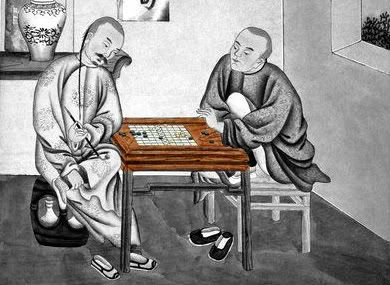
Ancient board game Go

Shibumi-  in Japanese, is an aesthetic of simple, subtle, and unobtrusive beauty.  

Or as I see it- a modest, but not to be underestimated, refinement.

Nicholai is referred to as Nikko in Japan where he trains under a Seventh Dan.  (Which I imagine is comparable to a seventh degree black belt for anyone who isn’t familiar with the Dan system)  

Nikko is destined to become a badass.

It is really strange to come across this book at a time when the same problems written about in the 1970s have multiplied.  Except, since these problems have gotten relatively worse over time, no one seems to notice them anymore.  

It’s funny to note that this novel doesn’t hold back in stating the issues.  Materialism.  There’s a concept where most people will turn a blind eye, but in reality it has spiraled seriously out of hand.  For anyone who’s been out of the country, it is easy to make a quick comparison.   

Also note through personal study, the Japanese never favored the merchant.  Merchants made nothing themselves but profited from the good work of others.  This reasoning is wise. 

Much to be learned from Shibumi.